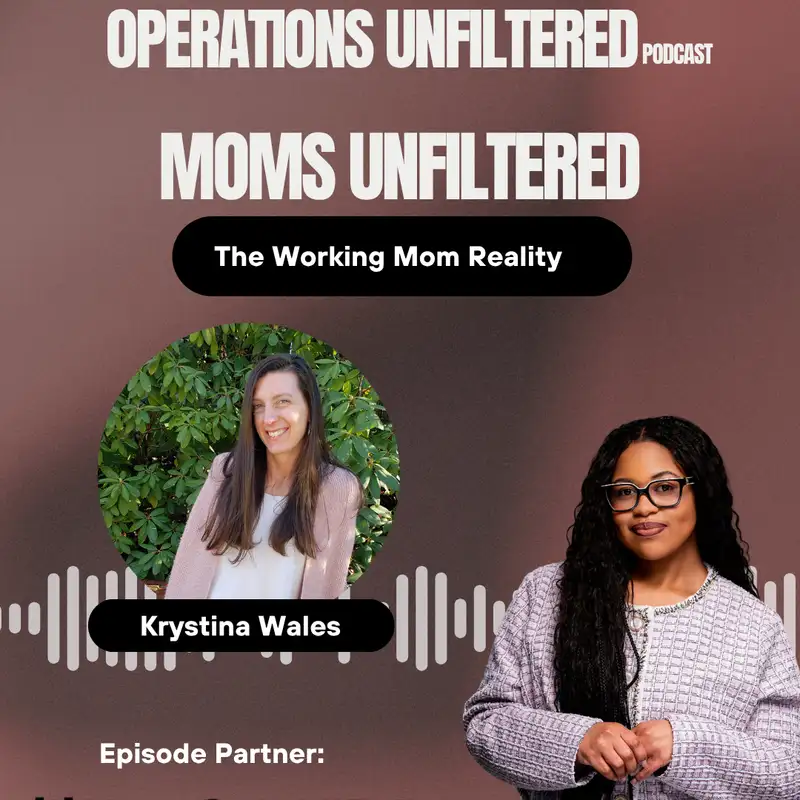
Zuryna Livermore: This episode of
Operations Unfiltered is brought to
you by The Tastery, serving food for
the soul with bold flavors and an
unforgettable culinary experience.
Founded by Chef Star, The
Tastery creates dishes rooted in
comfort, culture, and connection.
From handcrafted sauces and seasonings
to meals made with passion and
intention, every bite is designed
to nourish the body and the soul.
Whether you're gathering around the table
with family or looking for food that
simply feels good, The Tastery delivers
flavors that brings people together.
Visit www.tastery.co
to learn more about upcoming
events, catering, products,
and more soulful experiences
Welcome back to a very special Moms
Unfiltered edition of Operations
Unfiltered, the podcast that
takes you behind the scenes of
influencer and talent management.
I'm your host and your favorite marketing
project manager girly, Zuryna, and
today we are getting so personal.
If I'm being honest, motherhood has been
one of the most complex yet rewarding
project management experiences of my life.
Truly, there's no onboarding guide, no
standard operating procedures, and no
quarterly roadmap that truly prepares you
for balancing deadlines, daycare pickup,
emotional regulation, gentle parenting,
and trying to remember if you drank water
or met your protein goals for the day.
Honestly, this episode felt especially
important to me because I think so many
moms, especially ambitious moms, oldest
daughters, career-driven women, and women
of color, we're quietly carrying so much.
We're expected to perform at work,
show up at home, regulate everyone
else's emotions, and somehow
still make time for self-care and
healing in the midst of it all.
And one thing that really stood out to
me about today's conversation is the
idea that motherhood truly forces you
to slow down and confront yourself.
You have to confront the triggers, the
anxiety, and maybe even the little girl
version of yourself that maybe never got
comforted in the way that she needed.
I know we talk a lot online about
what being a good mom is, and I'm
putting air quotes around "good mom,"
but what exactly does that mean?
Does it mean that you
have the perfect routine?
Does it mean that you never lose your
patience, you're always saying yes?
Or it could mean that
you're doing it all alone.
We got into all of that and more,
and I'm so excited to be joined by
my guest, Krystina Wales from the
Greater Baltimore Medical Center, and
we discussed all things motherhood,
therapy, emotional wellness, and we
even tapped into what she does in
her regular job, healthcare marketing
essentially, we got into all the
things and the systems that keep life
running even when it feels chaotic.
We also got into the unfiltered side
of parenting, the fears, the guilt,
the moment nobody prepares you for,
and a reminder that maybe, just
maybe, we don't have to do this alone.
So if you've ever found yourself
crying in a Target parking lot, feeling
overstimulated by someone yelling, "Mom!"
500 times in a row, if you're the
one that struggles to ask for help
or question whether you're doing
enough, then this episode is for you.
So without further ado, let's
get into this week's episode
of Operations Unfiltered.
Thank you so much, Krystina for joining
me on this mom's unfiltered edition
of the Operations Unfiltered Podcast.
I'm so excited to have you
Krystina Wales: yeah, same.
Thanks for having me.
Zuryna Livermore: Of course.
Now, for those of us who might not know
who you are, could you please introduce
yourself to us and what is your role?
I know your mom marketer, host of
Practical Parenting, so just give
us the, the spiel on who you are.
Krystina Wales: Yeah, well, you nailed it.
So I'm Christina Wales.
I'm the Associate Director
of Media at GBMC healthcare.
So I handle all of our paid
and earned media strategy.
I also am a mom of two girls.
They're eight and six.
So we're getting into that.
Stage of life, I guess, where I can
do a little bit more things than
I guess I used to be able to do.
But yeah, and as part of my role there,
I also host a podcast called Practical
Parenting with our Chair of pediatrics.
We are on our third year of recording
and it's been fun to just talk
about different parenting topics.
Zuryna Livermore: Yes, and I've tuned.
Love that podcast.
Krystina Wales: Thanks for listening.
Zuryna Livermore: doing that.
Yes, and I can't wait to get to the eight
and six range because my daughter's three
right now, and I feel like I'm, I'm having
a lot of mom guilt 'cause I wanna do all
the things, but I also wanna be present.
So I'm excited to get
to that point in my, my
Krystina Wales: I feel that if
I feel like four was the turning
point, so you're so close.
Zuryna Livermore: She'll
be four next week.
So fingers
Krystina Wales: Yay.
Congrats.
Zuryna Livermore: Yes.
So with all the things that
you're doing, what does life
look like for you right now?
Are you super busy?
Are you managing at all?
Krystina Wales: I mean, it's crazy.
I feel like, you know, it's, it's never
not crazy, but for the most part, I
think we've gotten into a pretty good
routine now that they're both in school.
That makes it a lot easier.
But yeah, you know, just working Okay.
Zuryna Livermore: That is the hilarious
part about working in the office.
Krystina Wales: Yeah, so I feel
like in school, being them being
in school makes it a lot easier.
But yeah, it's just kind of working
during the day, flexing out when I can.
And then home with them in the afternoons
and then sort of on the weekends we're,
we're hitting the ground running.
Zuryna Livermore: Yes.
Now, what's something you've had to
let go of in order to function well as
both a mom and a working professional?
Krystina Wales: Other people's opinions,
Zuryna Livermore: Oh.
Krystina Wales: other people's
opinions and expectations.
I think you know, my approach to parenting
is definitely just whatever is best
for our family is what we're doing.
So if we have to skip an event.
Thank you.
Uh, if we have to skip an event or
we have to leave earlier or we can't
come, you know, that's just how it is
because we have other stuff going on.
So I try to prioritize their needs
in mind before everybody else is.
And then if we can fit you in, great.
Zuryna Livermore: How did
you get to that point?
I swear I'm struggling with that so
much because I'm a people pleaser
and I feel like I wanna help, I
wanna be there, but burnout is real.
How did you get to that point?
Krystina Wales: Are you
the oldest daughter?
Zuryna Livermore: Yes.
Krystina Wales: it's a, it's a thing.
I think all oldest daughters
have the people pleasing gene.
And yeah, it took a long time, a
lot of boundary setting, a lot of
therapy to be quite honest with you.
And some trial and error to get there.
But I feel like it's so important and
it relieves so much pressure from, from
you just and stress in the day to day.
And I think a lot of it too is just I
think it was Brene Brown that talks about.
The tennis court.
It was such a good analogy for me where
it was kind of like, imagine a tennis
court with a thing of glass separating.
You know, you where the net
is and people, other people's
feelings don't go over the net.
They bounce off the glass
and go back to them.
So whatever other people's feelings
are, it's not your job to take
them on as your own feeling.
So they're allowed to be
upset about something.
You don't have to.
I guess acquiesce to their needs
or take down your boundaries to
support somebody else's feelings.
Zuryna Livermore: I love that and I'm
glad you said therapy because that has
been such a big part of my journey and
motherhood has, I felt like amplified it.
I feel like that's part of
my necessities as a mom.
Like we
Krystina Wales: Yes.
Zuryna Livermore: about.
Self-care, but caring for the
self through therapy has been
crucial as part of this journey.
So you mentioned that, but what
role has therapy played in your
life, specifically as a mom?
Krystina Wales: I feel like having kids
has been therapy, and that's why I was
initially attracted to, we've talked
about this before, the internal family
systems approach to therapy, because
Zuryna Livermore: Yeah.
Krystina Wales: having kids is
such a mirror onto how you grew
up and how people responded to you
when you were a child and that.
That informs how you respond to your
kids when they are doing behaviors
that were shut down in you as a
child, or you know, things like that.
And you have the power to change that.
And so bringing all that.
Dirt up to the surface of how I was raised
and being able to address that directly.
You know, I always say I feel like this
generation, we're parenting our children,
we're parent reparenting, our own parents,
and then we're also reparenting ourselves.
So there's a lot of parenting going
on and it can be super overwhelming.
But I feel like being able to
incorporate that into all your
interactions with people is just,
it makes everything so much easier.
Zuryna Livermore: Yes, for sure,
and I'm glad you mentioned internal
family systems because that's
the mod, the direct modality.
I've always done cognitive
behavioral therapy.
I really wanted to try EMDR, but
right now we're trying out IFS and
that has been so eye-opening for me.
Krystina Wales: Mm-hmm.
Zuryna Livermore: I also, as the eldest
daughter, I struggle with anxiety and
depression, so I'm always go, go, go, go,
go.
And with IFSI really had to learn how to
slow down so I could actually acknowledge
that younger version of myself and.
As a black woman going through Internal
Family Systems therapy, there was a whole
bunch of cultural lenses that I had to
get through because Therapy Alone as a
woman of color is something that I had to
teach myself how to accept and appreciate.
So even this Internal Family Systems,
which is a whole different type of
therapy, it's like I really felt
crazy in some of these sessions, but
now I've done it so much.
I'm like.
Now I can identify that some of the
triggers and some of the things that I'm
going through, the little girl in me.
Krystina Wales: yes.
Zuryna Livermore: like you said,
I had to stop and, and acknowledge
tho how she felt in that moment
Krystina Wales: Yes.
Zuryna Livermore: mirror of
my child experiencing that.
I never want her to experience
some of the things that I did.
And so really, I, IFS has
taught me how to slow down.
So I love that you mentioned
that, but how do you.
Talk to your kids about therapy,
if you talk about it or emotional?
Well wellness, because I'm starting
to slowly talk to her about that.
We're introducing deep breathing
and she gets the little temper
tantrums and I'm always like,
let's go to the calm down corner.
So how do you introduce those
therapeutic practices to your children?
I mean, your children are older,
so I'm imagining it's a, a
much deeper conversation, but.
Krystina Wales: Now for sure.
But I mean, yeah, even when they
were younger, I feel like we
always centered around, I think
the two important pieces are.
Well, and I will just say if you have not
seen the movie Inside Out or Inside Out
Too, go see it because that is essentially
internal family systems for children.
Zuryna Livermore: exactly.
Krystina Wales: of my favorite
movies, but it, what it really depicts
is that separation between, uh.
You and your emotions.
So we talked a lot, even when they
were toddlers, about the fact that
you can feel anxiety or anger,
but it's not, you are not angry.
You are feeling angry.
And there's a difference between
letting it take over your entire
system, particularly with anxiety,
because my oldest struggles with that
a lot, is that that feeling is normal.
You, you should be anxious
about, you know, going to bed and
separating from mom for 12 hours.
Like that's a normal feeling.
Zuryna Livermore: Yeah.
Krystina Wales: So first normalizing
it and then letting you know that it
doesn't have to overtake your whole body.
You can control it, you can talk to
it, and you can tell it that it's okay.
You are safe.
There are things that you can say
out loud to help soothe yourself,
and it took a long time to get.
To the place where we found
what works for each kid.
So my oldest hates breathing.
In fact, they used to do it a lot of
in kindergarten, and she would do it
in kindergarten, and then they would
have like little homework when they
came home to practice breathing.
And she would say, I don't breathe.
I only breathe at school.
So breathing was not her thing, but
if she is in an emotional state where
she needs to calm down, I know that
if I hand her a piece of ice or a
cold glass of water, she's done,
she will calm down immediately.
But it took a while to find what works.
And my youngest totally different.
She will breathe and and
calm her body that way.
Or she'll go, she'll say, I know
I wanna go to my room and read.
And I'm like, go ahead.
So it's.
Recognizing and trying
different things out.
You know, particularly if you
have multiple children, but just
experimentation and trying to figure
out what, what helps them was also a
huge turning point, I think, for us.
Zuryna Livermore: No, that is
so helpful and understanding.
I don't have multiples,
but I'm planning for that.
So understanding that,
of course, every child is
different, but honoring what each child.
What makes them
different?
So I love that approach.
Now how do you regulate yourself,
you know, during those tough moments?
'cause I've had moments where my
child has completely had a meltdown
in Walmart and I've tried the gentle
parenting approach where I've sat down
with her as she's had her meltdown.
I've tried the cons, let's go
approach, and that doesn't really work.
'cause she's a lot like me.
And when you respond with aggression,
she responds with a, oh no,
don't talk to me like that, mom.
So how do you navigate in those moments?
Krystina Wales: I mean, I will say first
off, it's, it's incredibly challenging and
you're not always gonna be perfect at it.
So there are definitely plenty of times
where I have lost it and then had to
go back and, you know, we talk about on
the podcast a lot, and I feel like it's.
Always, the core to this is repair.
So if you don't keep yourself calm in
the moment, it's actually not a bad
thing for your kids to see that you're
not always great at this either, and
that you're in your thirties and still
struggling with regulating your emotions.
So like, of course you as a 4-year-old
are gonna struggle with it, and we're
all learning together, you know?
And so being able to go back,
being able to ask for what you
need and say, you know what?
Mom needs five minutes to calm her body.
I'm gonna go sit here and calm down and
breathe and having them see you do it
and then coming back and saying, I really
wish I wouldn't have yelled that way.
You know?
And not saying, but I yelled
because you did X, Y, Z.
You know, we don't do that.
But you know, I'm sorry that I yelled.
I'm gonna try to be better
about that next time and like
actually trying to be better.
Zuryna Livermore: Yes,
heavy on the apology.
That is something that I told myself
when I had kids, that it is okay to
apologize to my child because that's not
something that I ever really experienced
until later on in my teenage years.
And again, you know, we had
to reparent our parents.
Our parents did what they could with
the information that they had at
the time, but I was not necessarily
getting an apology from my mom.
Krystina Wales: Exactly.
Zuryna Livermore: So right now I am
putting an emphasis on apologizing to my
child, so I'm glad you mentioned that.
Krystina Wales: But I mean, breathing,
touching the wall, going outside, like
it doesn't have to be bit anything
that you would do with your kid.
Maybe I need a cold glass of water.
You
Zuryna Livermore: Yes.
Krystina Wales: be, you know,
just any, and it could be a little
thing that just puts you back into
the moment and, and honestly, I.
95% of the things that we struggle
with our kids are not an emergency.
Zuryna Livermore: Yeah.
Krystina Wales: like is is them
having a meltdown in Walmart?
Slightly embarrassing.
Sure.
But it's not an emergency.
And you know, I think most of the
moms that would see your kid freaking
out are kind of like, been there.
You know,
Zuryna Livermore: You
Krystina Wales: there's no judgment.
Zuryna Livermore: No judgment zone.
And what's, I always think about this.
When my daughter was at the
peak, she was two years old.
She was laying on the floor in Walmart.
She wasn't screaming.
It's just, I'm like, Zaya, get up.
We have to go.
No, I'm gonna.
So she laid there and I just
sat Indian style with her and a
mom came up to me and was like.
You are doing amazing.
I'm so happy.
I'm so proud of you.
I was like, thanks girl.
I really needed that in that moment
because not only did my child embarrass
me, but I'm embarrassed myself 'cause why
am I sitting at my big age on this floor?
But eventually she got up
and she apologized to me.
She said, mom, I'm really sorry.
I just wasn't feeling well.
And
Krystina Wales: Oh,
Zuryna Livermore: you know what?
It is okay.
It is okay.
In that, in that moment.
I was proud of myself
because I'm like, you know
what?
My kid has emotion.
She has emotional intelligence
Krystina Wales: yes,
Zuryna Livermore: and I didn't
lose myself in this store.
So that was one of the best moments.
Judgment free zone, shout out to all
my moms, and I made a point to make
sure that I do that to other moms
Krystina Wales: yes.
Zuryna Livermore: I was so mortified
and that person coming to me and
taking that time to say, it's okay.
Don't be embarrassed.
It's I see you now.
I do that all the time.
If I see a mom with a screaming
baby, I come over and make a joke.
I'm like, it's okay, girl.
We're not curing cancer in here.
It's fine.
It's all good.
Your BA babies cry.
You know what I mean?
Because I want people to
know that we all, we got
Krystina Wales: yes.
Zuryna Livermore: together,
Krystina Wales: Yes.
Zuryna Livermore: yes,
Krystina Wales: honestly, I'm glad
you said that 'cause just think
about that as a mindset shift too.
Like, you know how we sit there in
Walmart and think that everyone is
saying, Ugh, what a terrible mom.
Oh, she can't control her child.
What if we thought to ourselves
that everybody that walked by was
saying, God, that mom's doing it, and
Zuryna Livermore: yes.
Krystina Wales: she's
going through it and.
You don't know what they're thinking,
but if you tell yourself that it's
positive, then you can get through
that moment a little bit easier.
'cause you, you don't know if they're
thinking a judgmental thing or a
supportive thing, so why not give
yourself the gift of the assumption
that they're all supportive of you and
that they're all cheering you on, you
know, even though they're not saying it.
And just, even just that shift mentally
for yourself, I feel like just gives
you the, the energy to get through the
moment and move on to the next one.
Zuryna Livermore: Absolutely, and it just
makes you a stronger parent in general
Krystina Wales: Yes.
Zuryna Livermore: back to your point, I
don't care what other people are thinking.
My kid is okay.
She's not dying despite the screams
that she might be giving out.
So yeah, totally understand that.
Krystina Wales: Yeah.
Zuryna Livermore: Now let's pivot back
into marketing and the working mom life.
Now you work in healthcare marketing.
What's mis one misconception that
people have about marketing in that
space, especially in healthcare?
Krystina Wales: Oh yeah.
I mean.
This is loaded, but I feel like in
general, especially where we're at
in this time I have found that social
media is just loaded with people looking
for answers to healthcare problems and
finding them in very inopportune places.
So I guess the.
The struggle I feel like we have
on a daily basis is, you know,
healthcare moves incredibly slowly.
So we might not necessarily be on
TikTok or doing all of these things.
And to get the right information out
to people often takes longer than
what TikTok influencers would have.
You assume so.
You know, it's hard to fight that
noise that's so heavy with people,
you know, sometimes pushing their own
products or giving out information
that worked for them and doesn't
necessarily apply to everybody.
You know, and so fighting through that
noise and having it be, and I think that's
the other big thing too, is, you know.
Healthcare and health and wellness in
general is not a one size fits all.
So there's no magic pill or thing
that you can do that's going
to solve everybody's problem.
You know, there's no easy answer,
Zuryna Livermore: Mm-hmm.
Krystina Wales: I think people
need or desire the easy answer.
And so they're attracted to the
people that are giving them that.
And so fighting through the noise of
saying like, Hey, it might not be this
easy, not that we can't help you, but
it's gonna be a little more nuanced
than what people are telling you is
is hard to break through that noise.
Zuryna Livermore: For sure.
For sure.
And I am a marketing project manager.
I'm a manager for content creators,
and part of my passion project is
connecting content creators with
business owners to amplify their
mission, that digital marketing aspect.
But since healthcare is such a
regulated and sensitive field, and
to the, because of the points you
just mentioned, what is the appetite
for influencer marketing and content
creation now in the healthcare field?
Krystina Wales: I think we could
make it work with the right partners.
I know for us, we did try an
influencer strategy a while back
actually to promote the podcast.
And I was thinking, you know, long
term about how we could potentially use
people to say, you know, Hey, I had a
positive experience here with X, Y, Z.
You know, and I think that.
Honestly, that's what
social media is all about.
People connecting other people
with things that worked for them.
And so that trust factor and that
peer-to-peer is incredibly valuable.
You just have to find somebody that
can do it in an authentic way because
people can smell the inauthenticity.
And so if you don't have someone that's
actually used the product and actually,
you know, has really benefited from
it, you're gonna be able to tell.
Zuryna Livermore: For sure.
And then to that point, how do
you walk that fine line between
storytelling, especially those
patient stories, but then respecting
privacy and HIPAA laws and remaining
compliant and all of those things?
Because we have some amazing stories that
we want people to tell, but there's all
these red tapes, there's privacy things.
So how do you just navigate that,
especially while building out an
influencer strategy in healthcare?
Krystina Wales: Yeah, I mean, it has
to be patient centered and I think
that's the, that's sometimes the
struggle on our end is, you know,
wouldn't it be great if we had a patient
that hit this, this and this mark?
And you know, you can't, I mean, I guess
with ai, maybe you could create them, but.
Zuryna Livermore: Yeah, exactly.
Krystina Wales: But I
Zuryna Livermore: That's a whole
Krystina Wales: again, back to the au
authenticity thing, you know, we do
have an outlet where people can share
their story on a HIPAA compliant form.
And you know, it, everything is pro,
all their information is protected and
they sign, you know, a, an electronic,
you know, consent form to say like,
I am okay with sharing my story.
And then we talk to them about
what feels comfortable for them.
You know, so that's definitely an avenue
of people want to share and we, we tend
to hear things and have some more intimate
conversations with people about it.
So it's always really lovely when
you find stories like that that you
know, but I do think it makes it a
little bit more meaningful when you
do uncover that is like, oh wow, this
is a really great story that we can
use for a lot of different areas.
Zuryna Livermore: Yes.
I love those feel good moments.
I used to work at CareFirst and
I used, I worked specifically
in provider communications and I
felt like that was a hard audience
because they're actually working.
I felt like they were production.
So I always used to love when I got
assigned to those HI patients, well,
patient stories, those provider stories
and spotlight moments, because I felt
like you could get so much of their energy
Krystina Wales: Yes,
Zuryna Livermore: us
market what CareFirst was.
So I love telling those stories.
Fine.
Krystina Wales: and most people
that have a positive experience want
to share, so they're open to it.
You just have to ask.
Zuryna Livermore: Now, how do you deal
with the negative things that come up?
I know some, everybody has an opinion
and sometimes it's not always positive.
So how do you deal with that?
And have you ever encountered a negative
video or a negative review specifically
about GBMC and how did you handle that?
Krystina Wales: Oh, sure.
I mean, I feel like you should have our
social media person on to talk about that.
Zuryna Livermore: Oh,
Krystina Wales: but
Zuryna Livermore: a good time.
I sure will.
Krystina Wales: I mean, yeah, we try
to be as, as supportive as we can with
people who have obviously, you know,
negative experiences are gonna happen.
You know, we're a big organization.
We can't necessarily control everybody,
but you know, just trying to be listen,
listen and understand and just try to
support as much as we can and get them,
you know, what they're looking for.
And so try to, we, we do have
a patient, you know, compliance
that we can refer them to.
But we do try to include the
patient's opinions as much as we can.
We have a patient and family advisory
council that, you know, we run
things by so there's always a lot
of patient feedback whenever we do
something to try to make it as as
amenable to their needs as we can.
Mm-hmm.
Zuryna Livermore: I love that.
Always including the patient first.
So that's, that's what I always tell all
of my clients, no matter what industry
you're in, is feedback is so crucial.
Constructive criticism is super crucial.
I don't believe or subscribe to the
customer is always right mentality.
So that's why I'm like, I, I
Krystina Wales: Sometimes you
have to dig a little bit deeper
to figure out what's going on.
But I think we, that being said, I don't
think we take any negative feedback
lightly and we do investigate and try to
figure out like, where did that really,
what was the really the core issue and
how can we fix that moving forward?
Zuryna Livermore: For sure.
Well, we love a good business
process improvement, so I love
hearing that.
Now, other part of Operations Unfiltered
is we like to make sure that people
have the right people, processes, and
tools that they need to be successful.
So I wanna get into the systems
that keep you running both as
a professional and as a mom.
So we know organizational
skills that are survival.
So how do you and your
work team stay on track?
Do you guys use teams?
Are you how, what do you have
standard operating procedures?
What does that look like for you at work?
Krystina Wales: I feel like it's, that's
an ever, ever evolving thing, but I
know for me personally, if it's not on
my Google calendar, it's not happening.
Zuryna Livermore: Love that.
Krystina Wales: you know, I, I will
forget it if I don't put it on there.
But yeah, in terms we do use
Outlook products as a team.
So we use lists a lot actually
to track project requests
from around the organization.
So that has been a cool
iteration that we've developed.
In terms of tracking all of our projects
and we go through as a team regularly to
update and see where everyone is, what
support we need with different things.
So that has been very helpful
in terms of tracking projects.
And then yeah, we're still kind of
figuring out how to use Loop and all of
those other kind of tracking systems.
But for the most part I feel like.
Being a small team is helpful
because we can have more of
those personal conversations too.
Zuryna Livermore: for sure.
You guys seem like a nimble
team, so that's always helpful.
Krystina Wales: Yes.
Zuryna Livermore: I'm a Smartsheet girly.
I don't know if you've ever heard of
Smartsheet project management tool.
Listen, I love that tool so much and
they need to sponsor me, so I'm, look,
I'm gonna, I highly recommend that
Krystina Wales: Okay.
Zuryna Livermore: who's.
Worked in across different industries.
I've worked in healthcare, I've
worked in higher education,
and now in consumer finance.
I always tell people, if you're looking
for a project management tool or a work
management tool, Smartsheet is amazing,
Krystina Wales: Okay, I'm
gonna write that down.
Zuryna Livermore: exactly, what
tools or systems do you use to
keep your household in check?
Do you have like a skylight calendar?
I know you mentioned Google Calendar, but
what is, what keeps you in order at home?
Krystina Wales: You know what?
I'm a work in progress where
this, this is concerned.
I feel like my solution is just
do everything myself, which
is not an effective strategy.
So yeah, I feel like my, my
biggest struggle at home is
definitely asking for help.
I do not ask for it enough.
And I think we, you know, we talked
about this oldest daughter you know,
I think that is something that.
Moms like us, struggle with a lot.
And so, yeah, I don't have
a really great calendar.
It's all in my head.
Which for better or worse
you know, is where it lives.
But I think yes, asking for help can
definitely relieve some of that stress.
Zuryna Livermore: You are preaching
to the choir and we're having
a moment because that's me.
You're talking to me.
I
Krystina Wales: Okay.
Zuryna Livermore: for help.
Yeah.
So I see you.
I see
Krystina Wales: Thank you.
Zuryna Livermore: Now I wanna
get a little bit unfiltered.
This is the unfiltered part
of the Mom's Unfiltered
Krystina Wales: Okay.
Zuryna Livermore: What is your
most unhinged parental fear?
Like the one that gives you the
most extreme parental paranoia?
And it could be as simple as like,
I'll tell you mine, I don't send my
child to school with a full grape.
Like I have to cut her grapes.
I don't
care.
I want her, if she's gonna choke,
she has to choke with me so I can
give her the heim, like you will
not get a full grape at school.
That is my unhinged
parental paranoia fear.
Krystina Wales: I mean, gestures
wildly at the world right now.
There are so many things that I feel
like I could say to answer this question,
but yeah, I mean my most unhinged yeah,
I mean, I feel like just generally.
I will say I've gotten a lot better about
letting them do things on their own.
I think my husband is not quite there
yet, but you know, if we're often on a
walk, he's like, are they going too far?
And I'm like, they're okay.
Zuryna Livermore: Oh, he is a girl dad.
Through and through.
Okay.
Krystina Wales: Yeah.
But yeah, I mean, it's just, I mean,
yeah, it, it, the world is a scary
place right now, so I feel like
sometimes I feel like I'm probably a
little bit overprotective, but I also
feel like you never know nowadays.
Zuryna Livermore: to be.
Yeah.
Krystina Wales: trust your gut and
I feel like I just go with the gut.
Zuryna Livermore: No, I totally feel that.
And what's the recent mom moment
that you had that was like, yeah,
nobody prepared me for this.
Like, for example, my child has had
ear tubes three different times.
No one prepared me for that.
And I, that's not, I don't like that.
Krystina Wales: Yeah.
Yeah.
Zuryna Livermore: you had that
you're like, yeah, this is crazy.
Krystina Wales: My second
grader bullying her teacher.
I was totally prepared
for her to be bullied.
I had like a whole thing about
how we were gonna address that.
I was not prepared for her to be
the aggressor in that situation.
So that was a rough thing to navigate.
And here that your child is not being
the kindest, especially for someone
who prides herself on being kind.
Zuryna Livermore: Oh no.
Oh my gosh.
How did you handle that?
That's wow.
Krystina Wales: Yes, it was, it was rough.
But I feel like I feel like we just had
multiple conversations about, you know,
you know, the toughest part of it really
was respecting her feelings about the
situation that was happening, knowing that
she wasn't necessarily in the right for
the behavior that was going along with it.
So I think part of it was just
having honest conversations
about the fact that, hey.
You are not gonna get along with everyone.
Everyone is not gonna be your best friend.
I know you happen to have two
teachers that were stellar.
And you and this one in particular don't
necessarily get along, but you have
to respect her and you know, we need
to talk about what that looks like.
And you need to be aware of the
situation, not just about your role in it.
Zuryna Livermore: Mm-hmm.
Krystina Wales: you know,
for an 8-year-old, it did not
just take one conversation.
We had to have multiple
conversations about it.
And luckily talking with the teacher
and the administration, we were
able to figure out sort of a nice.
I guess meeting ground
to, to go through with it.
But yeah, that one was a tough
one that I was not expecting.
Zuryna Livermore: have not
even prepared for that.
Oh wow.
Thanks.
I'm gonna put that in my
Krystina Wales: Yeah.
Yeah.
Zuryna Livermore: Yeah, that's crazy.
'cause
Krystina Wales: Call me
if you need a script.
Zuryna Livermore: I sure will, because
I've been in that situation as the
student and having the parental lens now.
Oh my gosh.
I'm not ready for that conversation.
Yikes.
Yeah.
I'll be reaching
Krystina Wales: Yeah.
Zuryna Livermore: Okay.
We're gonna play a quick
game of rapid fire,
Krystina Wales: Okay.
Zuryna Livermore: or that.
I'm gonna give you two options and you
tell me which one you would go with.
Krystina Wales: Okay.
Zuryna Livermore: Okay.
Strict bedtime or flexible bedtime.
Krystina Wales: Oh, I mean, as
much as I hate to say it, flexible,
Zuryna Livermore: Ooh, okay.
I'll go.
Same.
That's me too.
Run errands with the kids
or wait until you're alone.
Krystina Wales: I do it with them.
Yeah.
Ever since they were babies, I feel
like I've always done it and I, I.
I dunno.
It's like a fun thing we do together.
I like them seeing that
adulthood is sparring sometimes.
Zuryna Livermore: Oh, I was gonna say fun.
'cause look, my, my me time
is walking through Target
Krystina Wales: yeah.
Zuryna Livermore: sometimes
I just don't need my toddler.
Mom.
Let's go down the toy aisle.
Mom.
No, I
Krystina Wales: So I have a tip for this.
So whenever you're in target or someplace
like that and your kid is asking
for every other toy, my strategy is
we're gonna take a picture of it and
we're gonna add it to your wishlist.
And I swear to you, every single
time they do not remember any
of the toys that they asked for.
They do not actually need it.
But if you take a picture, it's done.
Zuryna Livermore: That is hilarious.
The other thing, the other tip I'll add
for those with little babies, the toddler
section, I set a timer, so the timer is
five minutes, and we go down the to aisle.
You can touch, you can pull, you
can do whatever you need to do.
But when the timer is over, we're done.
We're leaving.
It's
Krystina Wales: I like it.
Zuryna Livermore: cosmetics section.
Krystina Wales: Yeah.
Where you can take pictures of
all the cosmetics that you're,
Zuryna Livermore: Exactly, exactly.
I think I would say both for that.
'cause I do want, I like when she
comes sometimes, but other times
I just need me, Starbucks and
Krystina Wales: yeah.
Zuryna Livermore: towel section.
So
Krystina Wales: Makes
Zuryna Livermore: Okay.
The other one, would you rather
step on a toy or hear Mom, mom, mom.
500 times.
Krystina Wales: Step on a toy.
500 times
Zuryna Livermore: Okay.
The last one.
Laundry forever or dishes forever.
Krystina Wales: laundry.
I actually like doing laundry.
Yeah, I know.
Hot take.
Zuryna Livermore: I'd rather rip each
one of my toenails out and walk around
with open toed shoes on than to ever fold
Krystina Wales: I don't know what it is.
It is like it's warm when
it comes out of the dryer.
I don't mind folding it.
Like, I don't know.
I just, dishes feel dirty to me.
I, I don't mind doing laundry.
Zuryna Livermore: Okay, we're
gonna have to do house chores.
Switches.
Krystina Wales: Yeah.
Zuryna Livermore: dishes.
You two.
Oh gosh.
So this has been so great, but what
does being a good mom to you today mean?
Not just what you thought it would
mean before you could have kids, but
what does being a good mom mean to you?
Krystina Wales: I mean, we say it on the
podcast a lot, but I do truly believe it
is parenting the child in front of you.
Like I honestly just, and I think
that's why I said flexible bedtime,
because you know, a lot of what I do
is just, it's kind of like wherever
we're at during the day, like I can
have all the plans in the world.
But if you're not feeling it
that day, it's not gonna go well.
And so I feel like I really try
to pay attention to my kids and
what they need and what they're
asking for in that moment.
And just listening to them and, and you
know, sometimes that means one kid gets
something different than the other kid
because their needs are different and
you know, fair doesn't always mean equal.
And I think just really paying attention
to the kids you have and addressing them
directly and their needs is how I try to.
To mom.
Zuryna Livermore: I love that so much.
And what's one thing you want?
Moms listening to this, which.
Want, what's one thing that you want
them to know or about giving themselves?
Grace.
Krystina Wales: Yeah, I mean, ask for
help and like I know that, like I said,
this is something that I'm working
on, but you know, I do try to think
I, you know, I learned a lot last year
that, and this can, can apply to mom,
mom, parenting and other things, but.
You can't give as much as you wanna
give if you don't also receive.
And I think that was the tough part for
me, is like realizing that in order to
give as much as I wanna give, I need to
receive in order to have more to give.
And so.
And, and how much I enjoy giving to
other moms and, and other people in
my life and how good it makes me feel.
I want other people to feel that in
being able to help me and just the
connections that you can create when
you help other moms and you know,
the relationships that you build.
Just leaning on that community and
being open to it, I think, you know,
there's nothing wrong with that.
You do not have to do this alone.
And you know there are people that
want to support you if you let them in.
Zuryna Livermore: That has
been my mantra this year.
You don't have to do this alone.
And I'm leaning on that more than ever.
So you saying that is just
really affirming that I need to
Krystina Wales: Yeah,
Zuryna Livermore: with that.
Krystina Wales: definitely.
Zuryna Livermore: I love that so much.
Well, where can we keep up with you
and listen to practical parenting?
Where can people find out?
Do we follow you on LinkedIn?
Give us all the things of how
we can keep up with Christina.
Krystina Wales: I mean, I'm on LinkedIn.
I'm embarrassed to say I'm not very
active on social media, but you
know, definitely follow me on there.
And yeah, you can listen to
practical Parenting on all the.
You know, podcast applications,
Spotify, apple, all that good stuff.
We release every other week we do a
longer form episode, and then one we
call a microdose, which is usually
about 10 minutes long where we go.
Just quick on a topic, but yeah,
and if you have any things you want
us to address, you know, I mean we,
it's a never ending pool of topics
we could discuss, but we definitely
wanna make sure we're answering
what applies to parents as well, so.
Zuryna Livermore: Oh, I love that.
Don't hit me with a good time.
I already have the topics
because the bullying situation,
these three-year-olds are mean.
Put
Krystina Wales: Yes.
Okay.
Zuryna Livermore: Toddler
Krystina Wales: getting you on to talk
about your stuff too, so you know.
Zuryna Livermore: Yes.
Okay.
Stay tuned.
Well, thank you so much, Krystina,
for joining me on this very special
mom's unfiltered edition of the
Operations Unfiltered Podcast.
Thank you so much.
Krystina Wales: Yeah.
Thanks for having me.