Zuryna Livermore: Hey, hey,
it's your favorite marketing
project manager, girly Zuryna.
And as the host of Operations Unfiltered,
I'm always talking about having the
right people, processes, and tools
that you need to be successful.
But one area that a lot of us
could really use some support
right now is weight management.
That's where GBMC's comprehensive
Obesity Management program, also
known as Comp, comes into play.
They're based in Baltimore, Maryland,
and their team really understands that
bariatric surgery isn't just a procedure,
it's truly a lifelong commitment.
Now, the COMP program offers a range of
services designed to support patients
before, during, and after surgery,
including nutrition, guidance, education,
and long-term support to help people
build sustainable, healthy habits.
Even if you're not local to
Maryland, you can still explore the
program and learn more about the
resources available, including their
medical weight management options.
You can visit gbmc.org/services/bariatrics
to learn more.
Now let's get into this week's
episode of Operations Unfiltered.
Welcome back to Operations Unfiltered, the
podcast that takes you behind the scenes
of influencer and talent management.
I'm your host and your favorite
marketing project manager, girly Zuryna.
If you spend any time on social
media, then you've probably
heard people say things like
weight loss surgery or GLP one.
Medications are the quote
unquote, easy way out.
At least that's the narrative.
What most people don't realize is
that obesity is actually classified
as a chronic medical condition,
not simply a willpower problem.
I know firsthand.
I personally had weight loss
surgery in 2018, and like many
people, my journey didn't end there.
Weight management is really long-term.
It's complex, and it often requires
multiple tools, including medical support.
Procedures like the gastric sleeve have
been performed for decades and are among
the most studied surgeries in medicine.
And after doing some research, I found
out that medications like Mounjaro,
which are classified as GLP ones.
Were originally developed to treat
type two diabetes before becoming
widely used for weight management.
I didn't know that.
So today we're having a chat about what
weight management really looks like.
I'm talking to someone who played
a major role in my own journey.
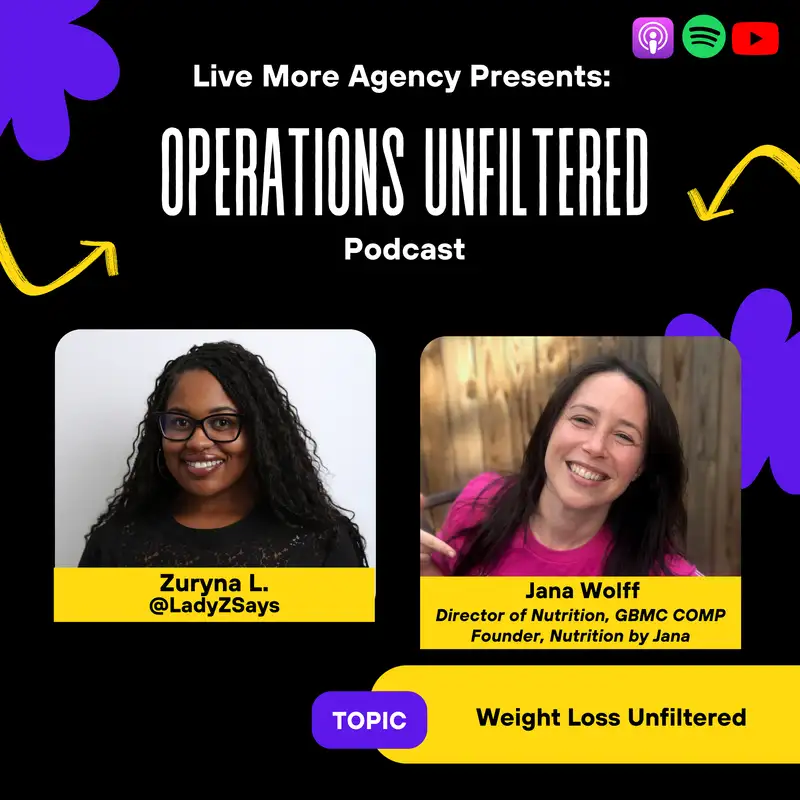
Her name is Jana Wolf and she's
the director of Nutrition at
the Greater Baltimore Medical
Center, or GBMC as we refer to it.
It's located in Baltimore, Maryland.
And this conversation was both
insightful and it just reinforced
why I went with this program.
Again, I'm very transparent
about my journey.
Follow me on Instagram at Lady Z
says, for videos about my experience.
But I just generally had a great
experience because of the education that
I've continued to receive from Jana.
So without further ado, let's
get into this week's episode
of Operations Unfiltered.
thank you so much for joining
Operations Unfiltered.
This is the podcast that takes my
listeners behind the scenes of influencer
and talent management with a little
bit of project management sprinkled
on top, and I'm very excited to have
a person who's been crucial to my
own personal weight loss journey.
Jana, thank you so much for joining me.
Jana: Thank you for having me.
I'm so excited to be here.
Zuryna Livermore: Yes.
Okay.
So before we get into the nitty gritty
of our conversation, I always like
to do a little bit of a mental health
check-in because the world is so crazy.
Things are happening, life is stressful.
So how are you feeling?
Jana: Yeah, it's definitely a
crazy world that we live in.
I feel okay right now because
daylight savings is coming soon.
So I know that the spring is
coming and I'm having a really
good time lately with my patients.
People are kind of like coming
outta that winter slump right now.
I think that it's, we're
emerging a little bit more now.
Zuryna Livermore: I love that
perspective, and I agree 1000%.
I feel like the winter is such a
hard time for me, depression sets
in, so I'm right there with you.
Jana: Yeah.
Zuryna Livermore: now the background of
this is, I know you because I've always
shared my, with my listeners that I'm
always on a constant weight loss journey.
And back in 2018, I can't even
believe it's been that long.
I had weight loss surgery and
you were part of my care team.
So you are officially the Director
of Nutrition for the Comprehensive
Obesity Management Program that I
lovingly refer to, everyone refers to
as the comp program, and it's at the
Greater Baltimore Medical Center, GVMC.
So how did you end up in that specialty?
I need to know.
Jana: Yeah.
Well, funny enough, I grew up very
overweight with binge eating disorder.
I saw my first dietician when I was in
seventh grade, and I looked at her and
I said, wow, this is what I wanna do.
Now it was kind of a roundabout
route because I first went into
work site wellness which is a.
I'll, I'll say right now for you
know, building up your own business
and everything on the side.
That was, that actually was crucial
for me because I came back around
to those old coworkers and I started
working with them on the side.
Zuryna Livermore: Mm-hmm.
Jana: with my LLC and everything,
but work site wellness, and
then I said, you know what?
I wanna specialize in nutrition like
I did when I was in seventh grade.
And, you know.
Interestingly, part of this is
because I'm interested in nutrition.
Part of it was to hold myself accountable.
, Part of it was to help others that were
having the same struggles as I was.
Everyone has their own unique journey
when it comes to, you know, weight
management, health, wellness, but if
you've been through at least a, a brush of
some of that, then the empathy is there.
You know, you can understand
what others are going through.
Zuryna Livermore: Absolutely.
And I think that that's why I
always resonated with you so much.
And even when we're able to pick
nutritionists and, and have appointments
with people, I always resonated
with you and I never knew that about
you, but now it makes sense i's why
I always wanted to meet with Jan.
I'm like, I need to meet with her.
That's my.
My dietician, registered
dietitian of choice.
Jana: Yeah.
Zuryna Livermore: get the lingo for me.
Is it, what's the official title?
Is it dietician, nutritionist?
What is the correct lingo
and what should we be using?
Because I know I worked at a massage
therapist and people would always
say, masseuse and massage therapists
are like, Ew, don't call us that.
It's massage therapist.
So what is the correct terminology?
Jana: Yes, this is the million dollar
question because it costs a million
dollars to become a registered dietician.
And so like nutritionist is the term
that you can use really for anyone.
When I was studying to become a
dietician, I called myself a nutritionist,
Zuryna Livermore: Okay.
Jana: I didn't have the licensure yet
and I didn't go through my so what
what you basically do is you get an
undergrad in sciences or nutrition
sciences, whatever, whatever is.
You know, whatever your interests are.
And then you will apply for an
internship and you have to do
that internship for up to a year.
And it's working and studying,
and then you take a test to, and,
and you take your test and you
get a licensure for the state.
So.
There's a couple of different
pieces to that, and then you have
to do, of course, your continuing
education all throughout the years.
Every five years they, you know,
re-up, you re-up your CEUs, so it's.
Zuryna Livermore: are very disciplined and
dedicated, and when people, essentially,
people need to put some respect on the
title, essentially, is what I'm hearing.
Jana: You know what?
I love to hear it and I agree with you.
And you know, we have dieticians at
the capitol, uh, fighting for all
different like legislature you know, to.
To like, get more coverage for
nutrition, medical nutrition therapy
you know, because a lot of that
sometimes isn't covered by insurance.
So, so you have registered
dieticians doing that.
And, and then you have, they won't hire
usually nutritionist in like a hospital
setting or an outpatient setting.
You're gonna have to be
a registered dietician.
Zuryna Livermore: This is all
helpful information, especially for
people who are on their weight loss
journey and they're looking to build
a team, or they're looking at, you
know, medical weight loss options.
It's always helpful to
have that information.
Now is there a difference between like
a general registered dietician and
someone who, uh, specializes in like
weight loss management or bariatric
nutrition, and what is that difference?
Jana: Right.
So when I was in my internship, I
I studied specifically bariatric
surgery for, for just a month.
You know, it wasn't like the whole
thing because when you're in your
internship, you learn everything.
You have all you learn about general
nutrition, you learn about, uh,
diabetes, hypertension, kidney health.
You'll, you'll work basically in
all different aspects of well,
uh, health care and nutrition.
There's also like working
in a kitchen for, uh.
Zuryna Livermore: Which is needed.
Like I would think you, you would
want to know how to make the
meals that you're telling people
Jana: Yeah,
Zuryna Livermore: you
Jana: think about, think about
hospital kitchens and you, you can
also work in the community with
like WIC programs and the USDA.
I mean, there's so many avenues
for dieticians to work in.
So to answer your actual question, yes,
there's a huge difference and you can
get specialized with different studies.
So like I became a certified, oh God.
A certified specialist in
weight management and obesity.
No.
Zuryna Livermore: that's a
mouthful, but it's so needed.
Jana: Yeah, so, so that's like,
that was a specialized test I took
with Stu, with studies, et cetera.
So like you can definitely
specialize in specific things.
You can become a diabetes educator.
That might be my next thing that I'm
looking forward to, between you and me
and the, and the rest of the audience.
So that's something that I was
looking towards in the future.
Zuryna Livermore: Is such, those
are some of the biggest things.
Like I feel like obesity is
such a big issue, but then
diabetes is such a big issue.
Colon, he, health is such a big issue.
So to your point, I, I think
there is such a need for these
specialties and we appreciate
the hard work that you're doing.
Jana: Thank you.
Zuryna Livermore: you for that.
And I'll be on the lookout for what
work you do in the diabetes spectrum,
because I have family members
who I need to connect you with.
Jana: Oh, great.
Yeah, and, and that's the other thing
about like, going back to the question
of the differences between like dietician
and nutritionist, we are flooded between
TikTok, Instagram, any social media with.
Influencers, which I, I love
influencers because they give me
actually ideas like for cooking and,
you know, just like different things.
But some of the nutritionists are
just telling you what worked for them.
So dieticians give you the perspective,
the objective perspective based on
clinical studies and you know, all of
the research that's been going on for
the past, like, you know, three decades.
Zuryna Livermore: That's a very
good differentiating point.
And I fall victim to be going to TikTok
University, so having the science
behind it is definitely needed, so I
Jana: Yeah,
Zuryna Livermore: that.
Jana: for sure.
Zuryna Livermore: Now I'm often, like
I said, I'm very open and transparent
about my own weight loss journey.
I'm currently on medical weight
loss management, you know,
to help with that journey.
Jana: Excellent.
Zuryna Livermore: would you say
is the biggest misconception that
people have about weight loss tools,
specifically weight loss surgery.
Jana: Yeah.
Weight loss surgery, I would say, you
know, nine times outta 10, if you're
just talking to a person that doesn't
really know much about it, is not in
the, in the health sphere they're gonna
say, uh, it's, it's the easy way out and
everyone always just regains back weight.
Well, isn't that a blanket statement?
If you've ever heard, I mean, truly.
Yeah.
And we live in a very weight phobic
society, so you're damned if you do,
you're damned if you don't, like, if
you, if you carry more weight, well,
they should be, you should be doing more.
If you are taking a GLP one, oh,
you should have done it by yourself.
Okay, calm down.
Let's, let's, let's actually look
at the fact that obesity is now
considered by definition a chronic.
Ongoing multifactorial disease state.
Okay?
So it's not just that, oh, uh,
you're not exercising enough
and you're eating too much.
Guess what?
Your fat cells are metabolic, and the,
and the bigger your fat cells are,
they can send signaling to your body
with different hormones to eat more.
How about, how about when you lose
weight, your metabolism goes down,
so your body's working against you.
Zuryna Livermore: you, you've
said this to me in our weight
loss meetings and check-ins.
'cause I'm like.
I know.
It it, the science of it truly gets so
overwhelming, which is why I cringe when
people say that GLP ones and the weight
loss surgery, they're the easy way out.
Because me going through the GBMC program,
it wasn't really the easy way out.
Like I had to do a lot of
things before to prepare.
So can you talk a little bit about
what the behind the scenes and
logistics work that needs to be done
before someone even considers this?
Like, what does that look like?
Jana: Yeah, I mean, if you are, so you
have to be at a certain BMI it's usually
a 35 and above with a comorbidity or
a 40 and above without a comorbidity.
Comorbidity being like type
two diabetes or sleep apnea.
And then.
You have to, usually, based on your
insurance company, they will give you
a number of nutrition sessions that
you have to complete with a dietician.
It's usually between three
to six sessions monthly.
Zuryna Livermore: take six.
Jana: Yep.
Yep.
And that, and that means that you're
in our program for half of a year.
You're in our program for six
months doing nutrition counseling.
I'll usually ask patients to like log
what they're eating so we can kind of
look at the data on you see objectively
what you're, you know, consuming and,
Zuryna Livermore: to gain weight anytime
we come in for a check-in as well.
Jana: okay.
So, so I a little bit has changed since.
2018, you can gain a little bit of weight.
But ultimately at the, towards the end
of the program, if you're following
the recommendations for the pre-op diet
which is typically a high protein, lower
carb diet for us, at least our program,
Zuryna Livermore: Mm-hmm.
Jana: you're gonna start to
see some weight losses anyway.
And if you're meeting with a dietician
and you have to have that accountability,
you might not even gain either.
And we, we kind of, keep track of
that so that you don't gain weight.
Zuryna Livermore: Exactly, which why
I, which is why I love this program
so much, is because I felt like I got
the support that I needed beforehand.
And I don't even know if this was a
requirement in 2018, but part of my care
journey was, you know, getting a mental
health provider and I got a a therapist.
Now, is that something that you guys
still require or is that something
that you even recommend from your
perspective as part of the journey?
Jana: Yeah, so th thankfully
the insurance companies require
a psychological evaluation,
Zuryna Livermore: That's
Jana: A letter of support from your
primary care physician, and then
there's other things that you might
need to do, like a sleep study or you
know, a stress test or something like
that, dependent on your health history.
But the psych piece of.
Is so important because, well, two things.
We take eating for granted.
You know, you do this every day.
You've been doing it for x number
of years, multiple times a day,
and then everything changes.
And I'm not talking about your
decisions change, I'm talking
about the way you eat will change.
I.
I work with people to take smaller bites,
chew more thoroughly, put your fork
and knife down in between your bites.
I call it hands-free chewing and
only picking it back up once you've
swallowed because you wanna slow
it down or else you can get sick.
So.
Zuryna Livermore: The thing that
was so hard for me, Jana, that
I remember you telling me was to
stop drinking while I was eating.
And that was such a struggle for me.
I mean, I felt it physically for the
first couple of months after surgery,
but like reteaching myself how to eat
so crazy and it was such like, I really
am grateful for my therapist during that
time because I thought I was going crazy.
I'm like, what?
I feel like a child.
This is so, so insane.
To your point, it's like you really
have to change your whole entire
relationship with the way you
eat, not just with food itself.
Jana: And coming to terms with it too.
So when you're working with someone after
surgery, that can be extremely helpful.
I mean, look, I think everyone in
the world should see a therapist,
Zuryna Livermore: Yes.
Jana: for multiple reasons.
But especially if you're going
through a major change in your life,
physically, mentally, emotionally,
it can only be a good thing.
Zuryna Livermore: Absolutely.
Absolutely.
Now, we talked about the importance of,
you know, the behavioral changes before
and after with nutrition, before and
after, and therapy, before and after.
Now talk specifically about the benefits
and what that relationship with the
nutritionist or a dietician looks like.
Post-op and or pre-op and post-op.
Jana: Yeah.
I, I did wanna add in one thing about
the emotional changes that can happen
after surgery, because sometimes there's
hormonal shifts, especially for women.
So, you know, like right before
you're getting your period,
you get a little bit emotional.
That kind of stuff can happen
right after surgery as well.
So that's something to keep a heads up on.
But it, it usually does
subside after a while.
Zuryna Livermore: Yeah, it takes a while.
Just, just personal story.
It takes a while.
Jana: While, yes, definitely.
But for the work that you'll do with
dieticians, what I like to do is take
sort of a, you know, a, a whole, uh.
What's the word I'm looking for?
A, a more like a bigger approach.
Like how is your sleep?
How is your stress level?
What do you actually have in your kitchen?
Do you even cook?
Do you have enough money to cook?
You know, are you going out to eat all.
Zuryna Livermore: holistic type of person.
You want the whole person, the whole
context of what, which I love about you.
I can't say that enough.
'cause I, in our conversations, you're
very aware of like socioeconomic type of
things and, and which I'm appreciative
of, which is why I asked this question,
like how, what does that relationship
look like before and after surgery,
especially at the GBMC facility.
Jana: Thank you.
Yeah, and that's, that's a huge compliment
because I do strive to make sure that
like everyone, everyone is different.
Zuryna Livermore: Mm-hmm.
Jana: has their own
unique experience in life.
Ethnically, societally, whatever,
you know, how you grew up.
There's also a lot of trauma around
food, you know, that, that goes back
to the psych piece of it, you know,
so there's, there's so many pieces of
like your life that you can talk about.
I, I do.
I, I kind of hate the fact that I
have to see patients once a month.
I think that it would be more
beneficial to see you guys like
maybe every two weeks or, you know,
something a little bit closer.
But regardless that's the reason I
keep myself open to communications.
Like you can message me anytime.
You can come to support groups.
I have monthly support groups.
We have walk-in groups for our program.
And then we have a Facebook group as
well where people can talk to each other.
So that touching base and making sure
that it's not just like what you do for
that half hour in your nutrition session,
Zuryna Livermore: Yeah.
Jana: and actually letting it bleed into
the rest of your weeks and your months.
And having a good support system
as well is what we strive to
like, push onto the program.
Zuryna Livermore: Yeah, that community
is so helpful, especially for beforehand.
Even the first few weeks after
I remember I was in so much
pain and that group helped me.
I find out about papaya enzymes.
Like I never heard of papaya enzymes.
It was like my little cheat
sheet for that full feeling.
So I just really appreciate all of those
different points of intersection for
us to have that community because it
really is needed as part of this journey.
So now the one part that I always
struggle with and I still struggle
with is like the compliance piece.
And I'm putting air quotes around
compliance, but what does that look like?
And what I mean by compliance is
where do patients struggle the most?
Post pop, pre-op, what is that?
What is that struggle point?
Jana: Yeah, so of course everyone
is so different and it's like, you
know, a lot of people think, oh,
I get the surgery and everything's
gonna change, and yes it does.
But the long, the longevity of those
changes is the most challenging part.
You know, after we call it the
honeymoon phase, the first six.
To 12 months is when people lose
more rapidly and consistently.
It's when your restriction in your
stomach is much more powerful.
And then over time your
body adapts and adjusts.
It should, that's normal.
But people panic and they're
like, oh gosh, it's a, that's it.
It's the beginning of
the end, old coming back.
Or God forbid something stressful
happens in your life and you just
go back to old habits that are
comforting you know, compliance.
And, and this will happen to everyone.
So weight is fluid
throughout the lifespan.
My whole thing is like, slip don't slide.
You, you know, everyone's
going to slip up.
That's to be expected.
But how far do you slide and when do you
come back to what's been working for you?
One of the best ways to comply, I
guess you could say with the program
is to come to your follow-ups.
We we have follow-ups right
after surgery at the one week.
Eight week, six month, one year,
and then annually after that.
And any of the, you know, support
groups and stuff are always a good
way to follow up because if you
show up, that means that at least
it's in the forefront of your mind.
Another way to comply is to
just log what you're eating,
because a lot of times we have a.
Zuryna Livermore: yell at me, Jana.
Jana: You know what?
None of this is ever based in
shame, and it's not confession.
So this is more like I want, I want
you to write down what you're eating
so we can see data and we can pinpoint
different things like let's say.
Let's say you get really hungry at night,
but then I look at what you're eating in
the middle of the day, in the beginning
of the day, and I'm like, wow, you need
more protein and fiber and roughage and
vegetables and things that are gonna fill
you up, and then all of a sudden later
on in the night, you're not as hungry.
So it's more like using it for prevention.
Zuryna Livermore: It's truly,
it's honesty hour for myself.
'cause when I did it consistently, I
would be like, oh wow, this is not good.
Or, I was honestly not eating enough.
To your point.
So it, it truly is.
I'm, I'm trying to look at it from
the lens of, this is not to shame you.
This is really to keep track.
And I'm a data girl at work.
I love numbers.
So I'm like, why wouldn't I do that here?
Ugh.
Jana: Yes.
And one of the, one of the best
pieces of advice that I've gotten
from just different, like therapists
and other dieticians, this is like
a, a big theme running is being more
curious instead of accusatory, oh my
God, I ate that, I ate that brownie.
Like what the, why was I doing,
why did I eat that brownie?
Hmm.
You know, you're gonna get
two different answers and the
accusing is never gonna help, but.
Curiosity will
Zuryna Livermore: Because
accusing automatically makes
my, makes me defensive.
Jana: correct?
Zuryna Livermore: I'm gonna definitely
take that as my action item for today.
I am definitely gonna
pivot, switch my mindset.
Jana: Yes.
Zuryna Livermore: Now, we talked
a lot about GLP one's, ozempic,
wegovy, Manjaro, all of the things.
Do you feel that medications
are replacing surgery or are
they acting as a compliment?
Jana: They're doing a it's and or so.
We actually set up a medical weight loss
program with comp, and we've been seeing
folks who are not interested in surgery,
or maybe that's an option later down
the road if the GLP ones are not a great
option for them, or, you know, you're not
getting, uh, your insurance company to
pay for them and they're too expensive.
Uh, so, so they can either.
Be in replacement of surgery or
they can be a compliment to it.
You will see though that a lot of
the studies that are coming out right
now are that for long-term weight
maintenance and loss, you're gonna find
a little bit more from the surgery.
It's, it's more, it's more of a durable
way of losing weight versus the GLP ones.
However, the GLP ones
are less invasive, but.
Hey, look, if you can't pay for them
because they're too expensive, or your
insurance company isn't paying for
them, or you have to stop taking them,
Zuryna Livermore: Yeah.
Jana: Wait.
Regain can occur.
Zuryna Livermore: Mm-hmm.
And that's a scary.
Fact to face.
So I always tell people who ask me about
my own personal journey, I've done the
surgery, I currently take GLP ones.
It's a very personal decision and
you just gotta weigh your options.
To your point, you gotta
weigh your economic situation.
I'm blessed to be able to have insurance
that pro, you know, pays for, but
I also had the weight loss surgery.
You know what I mean?
So I just, it's, I always tell people
to just consider what their options are.
Jana: Yeah.
Yeah.
Zuryna Livermore: Now I'm a mom
now and that was a crazy part of my
whole weight loss regain journey.
But one thing that's really shocking
to me, and I didn't see it before, I
had kids and I don't know how, 'cause
I also struggled with obesity when
I was younger, but I'm seeing a lot
more children, younger kids, even
children in my daughter's class that
are struggling with like obesity.
Like it's impacting them
younger and younger.
So how can parents talk about food
without creating that shame that you
mentioned, and how can we kind of
bring this to like, daycares and,
and bring our community more into it?
Like, what does that look like?
Jana: Making healthier food
more available, putting it out
on the countertops, you know,
getting excited about cooking,
Zuryna Livermore: Hmm.
Jana: making, making a
healthier option with your kids.
I.
And involving them, taking them
to a farmer's market showing
them where food comes from.
So again, it's more of like the curiosity
thing of oh, let me learn more about
this and where my food comes from.
And, you know, if you, the, the
problem is, is that it depends on
your environment because there are
unfortunately, like a lot of food deserts
and swamps and whatever you wanna call
them, that where, you know, your only
grocery store is a convenience store.
So that, that is a.
Different issue.
And there are other programs for
folks that live in those areas.
But in general, you know, having fun with
fruits, vegetables, lean proteins, whole
grains and introducing these things on a.
On, on a, in a balanced plate
and having meals together.
So this becomes a more positive experience
and making it also more accessible to
like, move around, make activities that
have exercise in them, fun dance, you
know, go on a walk, go on a hike, explore.
So these are all things that
support weight management long term.
And then lastly, I think that during
you know, during certain periods of your
life, you can actually gain a little
bit of weight, but then if you kind of
leave it alone and let your intuitive
fullness and hunger take over, like
there's this thing called intuitive
eating that kids do extremely well.
So not pushing your kids
to finish their plate.
Zuryna Livermore: Yes.
That is a lesson that I had to learn
or unlearn from my own upbringing that,
you know, it, it kind of feels funny
now that I'm implementing with my kid,
but when she's like, I'm done, I just
kind of gotta let her do her thing.
And it's so weird.
And my husband's Caribbean,
so he's the same way.
We grew up in the household of
like, you need to finish your plate.
Jana: Yeah.
Zuryna Livermore: just relearning that is.
Challenging, but it's so rewarding 'cause
I have a different relationship with
food, so I'm happy to teach her that.
So
Jana: Yeah.
Zuryna Livermore: echoing that.
Jana: Yes, definitely.
And I mean if, look, the whole thing
is that if they stop eating and they're
like, I'm no longer hungry, but then you
could say to them, okay, an hour later
if you're still hungry, I have some cut
up apples and bananas in the fridge.
You know, that you can have.
And if, and if you're really
actually hungry, you'll eat those.
If you're not really hungry and
you just wanna snack, there's
nothing really else available.
It's just the fruit for now.
Zuryna Livermore: Exactly, exactly.
I've done that and the tears have
flown, but hey, she ate the apples.
So I'm success in my book.
Okay.
You know what?
I didn't realize, Jana, you have
so many awards for patient care.
I saw, I did a little LinkedIn
scouring and I didn't realize that.
So congratulations, first of all, but
what do you think your philosophy is
when you're working with patients,
especially patients who feel like
they're defeated, or patients like me who
have a hard time complying air quotes?
What is your philosophy
with working with us?
Your
Jana: Yeah.
Zuryna Livermore: Children,
I like to call us.
Jana: Yes, safety and inclusion.
So,
Zuryna Livermore: it.
Jana: so no matter where you're from,
no matter what you're, what you eat, no
matter what your habits are no matter
basically your situation, we're going,
I'm gonna look at you and say, okay,
we're starting from, you know, the basics.
What's your education?
What's your knowledge?
And then let's build up from there.
You are the expert on your body.
I can give you recommendations,
but I don't know best.
You know best.
I know, I know the science and
what can work for you, but that's
all an experiment, you know?
So I'm gonna give you recommendations
and if something doesn't work,
we're gonna switch it up.
Okay?
Zuryna Livermore: that so much
and trial and error with you
has been like a game changer.
But again, that philosophy living in.
Breathing it.
It actually really works
and I appreciate it so much.
Jana: good,
Zuryna Livermore: you.
Jana: good.
And
Zuryna Livermore: honestly,
Jana: the shame from all of it.
Zuryna Livermore: yes.
You always say that.
Take out the shame from it.
I, I would say what keeps you
motivated to work in this industry?
'cause it can be super defeating.
I know.
I don't know.
I, I don't know.
I've recently, I've been pretty good
in our sessions, but sometimes I cry.
Sometimes it can be so heavy.
So how do you just keep
yourself motivated?
Jana: That's such a good question because
sometimes I don't know, like I, it's no,
to be honest, you know, I, I'm sort of
like a sponge with people's emotions.
And I take the.
In I,
Zuryna Livermore: Same.
Jana: yeah, and, and that's hard.
That's tough.
I have my own therapist that I see weekly.
Zuryna Livermore: I love it.
Jana: Thank you.
I have my outlets, I have my friends, I
have my family, I have my home, I have my
dog, and I go to the gym very regularly.
You know, those are the, the things
that I have control over, which is
like what I put in my body, what I do
with myself and, and the narrative that
I have in my own brain is, is what I
have to work on on a regular basis.
Zuryna Livermore: It the negative
internal self critic, and my
therapist tells me to name it.
So that way when it's happening,
you can call the girl by her
name and be like, girl, relax and
Jana: Oh my goodness.
Ah,
Zuryna Livermore: You just tell,
call her name and tell her Relax.
Jana: yes.
This is similar to the
internal family systems.
I don't know if you've seen.
Zuryna Livermore: That's the, the, that's
the exact modality I'm doing right now.
Jana: Yes.
Oh, I love that.
I love it.
I love it.
That's great.
I, I've used this, actually, my,
my therapist right now uses that
and that's why I picked her.
Because it, it makes it a lot.
Again, it ma it takes
away the shame of it.
It's like, yeah, that, that voice
that's telling you, you know,
whatever is, it exists and you
start sort of make peace with it.
Zuryna Livermore: And that is the key
for me because for a long time I thought
it was me talking to me and that it,
this might sound so crazy to people.
It might sound crazy to you, Jana,
but I really was like, I had to
determine that this was not me.
This was an internal self critic that was
brought on by life events and trauma and.
people, so I had to really again,
name that person so that way I
could be like, this isn't me that's
Jana: Yes, yes.
Zuryna Livermore: see each other.
Jana: for sure.
And actually I use that at,
with some, with some patients.
If there is a lot of like negative
self-talk, shame like beating yourself up.
I'll say that is, that is a voice.
That you can,
Zuryna Livermore: me that.
Jana: yes, yes, that's right.
You can say Thank you so much
for giving me that feedback.
I'm not in that space right now.
It's not helpful for me right now.
I'll take note of it and
then we'll loop back.
You know, when I actually.
Zuryna Livermore: so nice
of how you talk to them.
'cause I curse the girl
out, like I let her have it.
'cause it's like, girl, you can't
talk to me like this anymore.
You know?
So I, I'll try to be gentler
with her because then that'll
show me that I've grown.
But these past few months I've been
letting that internal critic have it.
Jana: Okay.
I think that that's, maybe I need
to do a little bit of that too.
Zuryna Livermore: just a little bit.
We don't have rage rooms
in the Baltimore area,
Jana: Okay.
Zuryna Livermore: if you just
rage out on your internal critic.
It helps.
I highly recommend it.
Jana: I love that.
I love that.
Zuryna Livermore: Yeah.
And Jenna, you are so busy and I
always ask my guests this because
I like doing, talking about the
project management of it all.
Jana: Yeah.
Zuryna Livermore: do you
keep yourself organized?
Are you like a pen and paper type of
girly, or are you a digital vibes?
Jana: So this is, I am a
pen and paper type of girl.
I I.
Uh, and I will say like, you know, in
2020 I built an LLC nutrition by Jana.
I, I have had different, you know,
like arms of that where I was
doing bariatric meal delivery.
I'm no longer doing that because
it put way too much stress on me.
Zuryna Livermore: Only doing
things that serve us this
Jana: Yes, exactly, exactly.
And what serves me is my consulting.
I work with old coworkers of mine and
I do nutrition education for like a
wellness program for a big company, and.
Zuryna Livermore: that.
We love education.
Jana: Yes, yes.
And then I do one-on-one counseling with
really anyone in the community, uh, that
doesn't really like, that doesn't qualify
for our program, so the comp program.
So I'll see people outside
of our program as well.
Zuryna Livermore: That is good to
know because I serve on the board
of some patients programs and I'm
definitely gonna connect you with them
because we could definitely use you.
We don't have like a nutrition arm just
yet, so I'm gonna connect you, but.
To that point, I always ask my guests too.
Do you feel like you're, because
we're in the era of content creation,
I'm sure you've been at the grocery
store, you see people making tiktoks
in the store, and then you even said
that you do look at some dieticians
and nutritionists online for inspo.
But do you consider yourself an
influencer or content creator or
even, you know, a thought leader?
Because you do have these online
communities where you are influential
and you do create content via
assets and things like that.
So do you think of yourself like that?
Jana: Yes and no because for,
and, and it depends on the season
of life that I'm in, because,
Zuryna Livermore: That's a valid answer.
Jana: right, because for the
first, let's say you know.
Six, seven years in my career at GBMC.
I was, I was online 24 7 doing videos,
creating stuff You were asking about
like what applications I use like through
Canva and you know, doing challenges with
the patients and all of that and that.
It, it honestly like overwhelmed me to
a point that I was really blurring the
lines between my job and my personal life.
And it was kind of making me unwell.
So, uh, it was just too
stressful, too much time.
Zuryna Livermore: Mm-hmm.
Jana: and then, you know, I
moved into like really just
focusing on the educational
content for our patients, so I.
Zuryna Livermore: is so great, by the way.
Like I still have the reset and recommit.
I do that, like whenever I feel like
I'm eating too much and I'm going off
the rails, I'm like, you know what?
Let me get my packet out.
Reset and recommit.
Jana: Yes.
Yes.
And we've, we've created meal plans,
grocery lists meal swaps, you know,
different specialized things for like,
you know, vegan or kosher or whatever.
So that.
Zuryna Livermore: I need to touch
in touch base with you 'cause you
know I'm in my Vietnamese era, so
we're gonna have to talk about this
Jana: Oh yeah, I did see on
your, I, I saw on your Instagram
the fa oh, that looks good.
That looks good.
I love that.
But
Zuryna Livermore: to have a talk 'cause
I need to, we need to bariatric fify that
maybe we can create some content together
Jana: yeah, for
Zuryna Livermore: that type of
Jana: that, for that, it's just the
ratio of like increasing the amount of
protein and vegetables and decreasing
the amount of like vermicelli noodle.
Zuryna Livermore: Okay.
Jana: That's it.
Zuryna Livermore: All right.
So you're not saying look at, look at her.
She's saying, she's not
saying I can't have it.
You
Jana: No.
Yeah,
Zuryna Livermore: it,
which is why I love you.
So
Jana: yeah.
Work smarter, not harder.
So I, I think that to go back to your
question, I, I was just recently asked to
talk at a conference actually, in May, and
I haven't done that in such a long time.
I used to do that.
I have to take a break to be quite honest.
You know, I'm in my forties.
I, I went through.
Zuryna Livermore: not.
I need id Jana.
That's a lot.
Jana: Thank you.
Thank you.
I, I mean, I went through a lot of stuff.
I went through a divorce.
I went through shutting down
this meal delivery service.
The, you have to understand, like
once you're, once you've gone
through decades in a job or in
a field, you're just gonna have.
Different seasons of life where like
you are able to put in every single
cell of your body into something and
then otherwise where you do have to take
a step back and just kind of let the
workflow and you know, do what you can.
The last few years for me have been
really more focused on my consulting
and GBMC and not overworking
myself because I got that divorce.
So I had to really, you know.
Manipulate my schedule and
time and not feel bad about it.
Zuryna Livermore: I love that
so much and you are inspiring
me and you don't even know it.
So I thank you and you know what I like.
I'm happy we're having this
conversation and I hope that so many
people resonate with it and, and book
services with you or come to comp
just so they can get your energy.
'cause it's,
Jana: Oh,
Zuryna Livermore: they need it, you
Jana: thank you so much that see that.
Okay.
You asked me how do.
Zuryna Livermore: Well, I'm happy
to be part of it, so thank you.
Now I wanna keep the, the love fest going.
So how can we help people
pour into themselves?
What does success look like
beyond a number on a scale?
Jana: Oh gosh, it is being able to take
a full walk around, you know, Montebello
Lake and uh, or Lake Montebello and
you know, not being asthmatic or, you
know, feeling like you can actually
do that or tying your shoes and not
having, not being out of breath.
Zuryna Livermore: What it was for me.
It was the first time I flew and didn't
have to ask for a seatbelt extender.
And the first time I, I sat on like
public transportation, a train, and
I wasn't spilling over into the seat.
And these are small things that people
laugh about or they make fun, but these
are very real experiences and it's.
It truly is success or wearing
clothes that I never thought I could.
When I wore a two piece for the
first time, Janna, oh my gosh,
I, I got pregnant the next year.
But I mean, hey, you know, it was like,
Jana: Because of the two piece.
So
Zuryna Livermore: it was success.
It was, and I'm like, I, I want people
to hear it from, from the dietician,
from someone who's experienced this.
That success is beyond
the number on the scale.
Jana: actually the number
on the scale is irrelevant.
We carry around.
Zuryna Livermore: wait.
Stop the presses.
What did you say?
Jana: This just in the number on
the scale for your own progress
and peace of mind is irrelevant.
We walk around in our
body all day, every day.
We don't walk around with
a number on our forehead.
You know, this is, if you feel better
in your body, then you know the scale
can tell you multiple things, you know?
You're gonna gain weight if you
haven't gone to the bathroom
in a couple of days, or if you
Zuryna Livermore: Yes.
Jana: a very, you know, high
sodium meal or you know, if
you've been lifting weights.
Okay.
So
Zuryna Livermore: I've cried on the
scale before because I remember I spent
all this time I was doing hit, I was
doing strength training and I just
wanted the scale to be under 200 pounds.
So, and I was in the best shape
of my life and I got on that scale
and it said 2 0 2 and I cried
Jana: yeah,
Zuryna Livermore: you I
Jana: mean, meanwhile.
Isn't that so sad that a stupid
little number on a stupid little
scale brought you down after you were
feeling so excellent about yourself?
Zuryna Livermore: and I could lift a
car like theoretically, of course, but
I was like, Ugh, I was so svet, and I'm
like, I cried over 2 0 2, never again.
Jana: And, and, and stepping on that scale
and seeing that and crying, that could be
a turning point in the wrong direction.
So you don't want to actually
have that as like, you know,
it's not a one-to-one exchange.
It's not like, oh, I exercise
so I deserve to lose weight.
It's like you, you exercise so
that you can stand up straight when
you're in your sixties, you exercise
so that you could sleep better and
have more endorphins and feel better
about yourself and be stronger.
You know, it's, it's just not a
one-to-one exchange on the scale.
Zuryna Livermore: I love you for that.
Thank you.
So if someone is feeling overwhelmed
about their weight loss journey, they
don't know where to start, they've started
and stopped a hundred times, what's one
practical first step that they can take?
Jana: One first step that they can take
is, number one, finding a dietician.
If, if.
Zuryna Livermore: it.
Jana: You want, if you want to talk
to someone in a realistic way or just,
you know, logging what you're eating,
just writing it down and visualizing
and getting comfortable with what
you eat or just, you know, stepping
outside and going on a 15 minute walk.
I mean, truly,
Zuryna Livermore: Slow and steady starts,
wins the race or whatever the saying is,
Jana: yes.
Zuryna Livermore: little steps.
Little
Jana: Yes, yes.
Tiny Habits.
That's actually a book.
I forgot his name, the author, but
they've done Ted Talks and stuff on it.
Tiny Habits.
Zuryna Livermore: I'm gonna add
that to the episode description,
so thank you for sharing that.
We could put that on Janice's
recommendation, Janice's recommended list.
I
Jana: Yay.
Okay.
Good, good.
Yes.
And I just, I also wanna say this ex,
because we were talking about exercise.
Exercise should be looked at
as like brushing your teeth.
Zuryna Livermore: Mm-hmm.
Jana: should not be looked
at as a means to weight loss.
It's helpful to burn calories.
It's helpful to manage.
Like once you lose the weight,
it's helpful to keep it off and to
build up muscle and for longevity.
But it should be a maintenance thing.
It should not be the thing
that makes you lose weight,
because that's not how it works.
You can eat two spoon fills of something
and that could be 300 calories.
That's two seconds of 300 calories,
and that takes a much longer time and
it's much harder to work that off.
So it should just be an accompaniment
and a maintenance thing for your body,
not like the, the thing that makes
you lose weight, if that makes sense.
Zuryna Livermore: It makes complete
sense, and I think for a long time
I was operating in that sense.
But again, with all the tools and
resources, I'm, I'm in therapy.
I'm learning to retrain my brain.
Jana: Yes,
Zuryna Livermore: appreciate you for
explaining this to everyone and I hope
that people leave with some action items.
I hope that how can people get in touch
with you or, or get in touch with a
comp program if they wanna explore,
you know, weight loss options and,
and get started on their journey.
Jana: Yeah, so, for comp, if
you wanna look into our program,
it's gbmc.org/weightloss,
and then for me it's
jana@nutritionbyjana.com.
That's my email.
You could just email me directly.
Zuryna Livermore: I love that so much.
All right.
Well, thank you so much for joining us
and I hope that everyone learns something.
I always have a great time talking to you,
even during our nutritionist appointments
when I am not compliant, but I appreciate
you for always accepting me and motivating
me, so thank you for joining me today.
Jana: Oh my God.
Thank you so much for having me.
This was my pleasure.
Zuryna Livermore: Yes.
All right.
See you next time.